
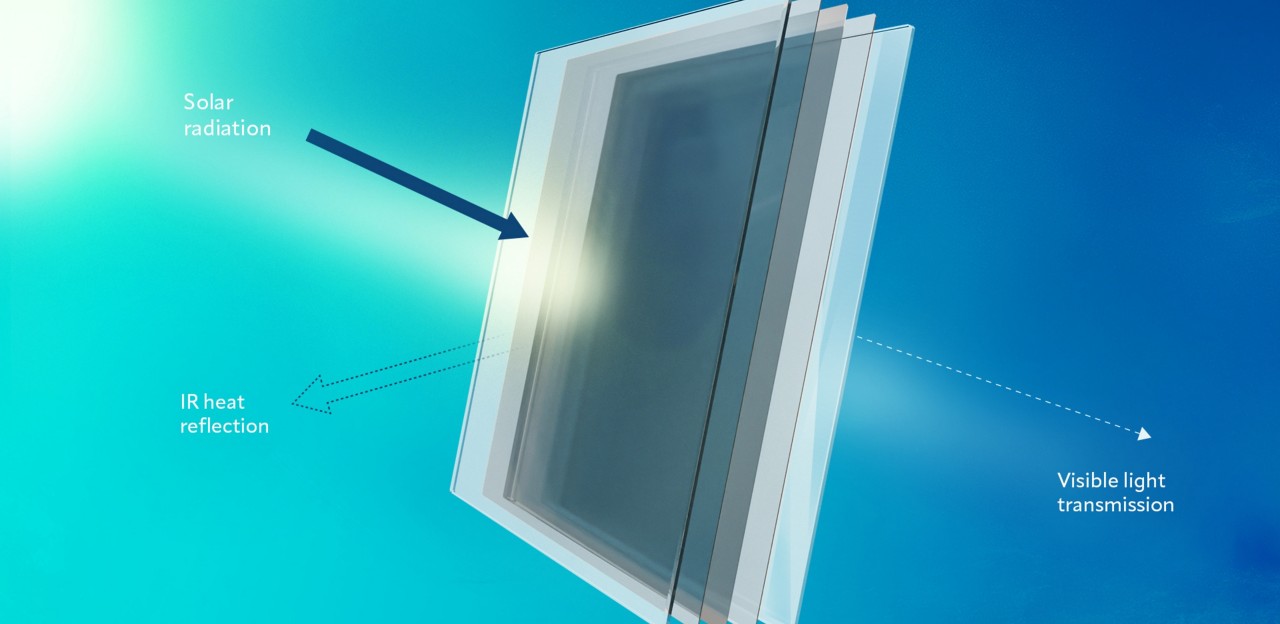
More than thirty years ago in California, a small team that would become part of the Eastman advanced interlayers division had a simple idea: block infrared heat inside laminated glass. The thin-film technology they developed, XIR, started as an energy‑saving solution for building windows that reflected infrared rays (IR) while keeping glass visually clear. That same approach was later adapted for automotive glass to keep vehicle interiors cooler without sacrificing safety.
Today, Eastman celebrates over 30 years of Saflex XIR, a technology that still performs reliably and protects what matters.
Over the decades, XIR went through changes in ownership and evolving challenges. XIR technology entered the Saflex product portfolio when Eastman acquired Solutia in 2012, expanding XIR global reach and engineering scale. Through it all, Eastman’s global team of experts have continued to innovate and deliver high-quality interlayers.
"One of the most valuable outcomes of the Eastman acquisition was not just the IR‑rejecting film technology but the expertise to integrate functional films into automotive‑grade laminated glass," said Michael Johnson, business development manager. Johnson, who has more than 30 years of experience in automotive OEM and related technologies, became part of Eastman through the Solutia integration. “This knowledge also translates well into supporting the proliferation of dynamic, switchable glazing and numerous other technologies.”
Saflex XIR is now used globally as a transparent automotive film with a spectrally selective metallic coating that reduces solar heat gain. When combined with Saflex PVB interlayers and laminated into glass, XIR can reduce solar heat transmission by up to 25% compared to IR-absorbing PVB interlayers.* This can result in cooler interiors, lower air‑conditioning loads and improved energy efficiency.
Rise of EVs drives new XIR innovation
Prior to the evolution of electric vehicles (EVs), there was limited need to upgrade XIR. The product delivered consistent, dependable performance for windshields and side windows. Then EVs began to reshape glazing priorities. In gas-powered vehicles, the engine could compensate for some of the cooling demands caused by solar heat entering through the glass. For EVs, however, larger glass surfaces — especially sunroofs — allow more heat into the cabin, which can impact driving range. As a result, Eastman’s focus has shifted toward new applications and higher-efficiency interlayers.
“Over the past couple of years, we recognized a growing need for a high‑efficiency IR‑reflective interlayer for electric vehicles, and we have developed a new product that will be launching soon,” said Ingo Kramer, Eastman business development manager, who has more than 30 years of expertise in automotive glazing industry.
For 30 years, XIR has enhanced comfort, saved energy and enabled flexible design. Looking forward, the mission remains the same as when it began: preserve optical clarity while blocking more infrared heat. Now, the goal is to help EVs travel farther on a single charge by improving IR performance.
“Today, Eastman is uniquely positioned to address challenges in EVs related to solar control that can improve cabin comfort and help extend battery range,” said Jamie Dziczkowski, electric vehicle platform manager for Eastman. “With decades of expertise in XIR and PVB technologies combined with rich application experience, our global team is committed to developing IR products that continue to perform and protect.”
Coming soon: Saflex Evoca XIR.SR.
See what’s next — sign up.
*Based on internal total solar transmittance measurements comparing Saflex XIR to IR-absorbing PVB interlayer Saflex Evoca S series. Performance may vary depending on glass configuration and environmental conditions.

